I had previously encountered problems syncing calendar appointments from exchange server to my Android phone. I had brushed them off because I could resolved them somehow, though most of the time it’s through factory reset (which in retrospect, is a silly resolution mechanism)
It got worsen recently. Despite umpteen times of factory reset and exchange account settings, I just could not get the calendar appointments to download into my phone. I noted that the sync did occur, albeit just one-way; Appointments created in the phone are synchronised automatically into Exchange server, but not the other way round.
Googling for help was not easy. For most part of the google search results, it was more of an affirmation that there are people around that experienced the same problem as I did, than a resolution to the problem itself.
Just as when I almost wanted to give up, I came across a post in xda-developers.com, about how the sync issue could be attributed by a corrupted calendar entry.
It sounded silly to me, but I recalled it did happen to me before, back then when I was using Windows Mobile phones. The Windows Mobile Activesync would however highlight the cause of the problem, whereas in the case of Android, nothing is reported and the sync process just start and stop within second, quietly.
Given that I have already exhausted all possible solutions, I figured out there is no harm looking at this possibility. So I moved all my calendar entries in exchange server to a temporary offline folder, before copy them back in batches to narrow down the offending entry that causes the whole synchronisation to fail. Lo and behold! I managed to find the offending entry, deleted it and the calendar synchronisation process resumed back to normal!
Hopefully this blog would provide some help to folks who encounter similar problem. At least doing google search would yield some results that offer resolution rather than just problem reporting.
Young Lion Cubs celebrating their goal - taken by unknown reporter
Earlier this evening, I went down to Jalan Besar stadium, to witness an exhilarating 3rd/4th playoff match between Singapore and Montenegro. The boys had earlier beaten Montenegro during the group stage, so like the Haiti match, they walked onto the pitch as a favourite. But I believe they have learnt the lesson of humility by now, given how they remained focus this time round to give a convincing 4-1 win over Montenegro boys. Their opponents are physically stronger and taller than them, but the Young Lion Cubs were unfazed with their trademark slick passing and technical skills.
What rolled my eye this time round is not Montenegro team, not the match officials, and definitely not the fans that were present in the stadium, who were great by the way. It is how some of our fellow Singaporeans think about the game. and I hope they are just minorities. Here are some excerpts from the Yahoo! YOG Blog
Just what are we celebrating? Where’s Germany? Spain? Holland? Korea? Japan? The cubs line up against Papua New Guinea, Montenegro, Haiti…are these power houses of soccer? I think not. Yet, they choke against Haiti.
Give yourselves a pat on the back, for Haiti lost 9-0 to Bolivia and yet you couldn’t contain them. It could’ve been a blessing in disguise. Had you triumphed over Haiti, who knows what sort of trashing awaits you against Bolivia?
Lets hope you keep your feet on the ground. This medal means nothing given that soccer-strong nations were noticably missing to begin with.“
and then there’s another one
… Anywhere, there is nothing to shout about. There are only six teams in the Youth Olympic and Bolivia is the only outstandinng team with their good technical passes. There are no Brazil, no Argentina, no England, no Italy, no Germany, no France, no Spain, no Holland, no Uruguay, no Mexico, no Portugal and even Asian giant Korea and Japan are no in the line up. If all these team are in the Youth Olympic, where would Singapore stand???
Having read some of the criticisms about Singapore Youth Olympic, to be honest, I was expecting cynics and pessimists to spoil the party. But I can’t help thinking that some of these comments are a tad too much to stomach, let alone to be digested by a team of spirited boys. There seems to be a group of Singaporeans who would only complain and criticize at every opportunity they can find, and appear to gain joy just by doing so.
To “critics” who want to compare us with the likes of England, Brazil or Spain;
The fact is, we are a young nation. When England won their first (and only) world cup (in 1966 fwiw), we were just barely few days away from celebrating our first independence day. When we think Spain as a powerhouse today, think about the struggle and challenges they faced in the last few decades (up till 2008).
If the boys had the same mentality as some of these “critics”, i.e.there’s no powerhouse (and therefore there’s no pride in winning the tournament), where would they be today? They would probably just “go through the motion” with a half hearted belief, and ended up crashing out at the group stage. They might then do all the self-pity consoling stuffs, giving all sort of reasons why they cannot win.
But I’m glad the boys did not, and hold on to the positive mindset, which the party-poopers are clearly not capable of. That they managed to overcome the Haiti setback to have a convincing win against Montenegro tonight, is even more commendable.
My parting words to the Young Lion Cubs, never stop believing and dreaming, as long as you work hard for it. If they do, we should applaud them for their sacrifice and determination, no matter whether they are successful in the end or not at the international level.
I watched the 1st Youth Olympic Football semi final yesterday night, where Singapore, my home country, faced Haiti, a team that was thrashed 9-0 by Bolivia in the group qualifying round. Naturally, Singapore was a favorite coming into the match.
As the saying goes, in football, anything can happen. And true enough, Singapore was stunned with a 2-0 defeat, thanks to a goalkeeping blunder, and a controversial penalty converted in the last minute of playing time.
Well, the Young cubs, as the Singapore boys are better known as, should hold their chin up despite the defeat, for they have come so far, and had proven their worth with the skills and grits they have displayed in their journey to the semi final. They had earlier beaten Zimbabwe 3-1 despite the latter boasting a prediction of 5-0 thrashing during a pre-game interview. They managed to overcome Montenegro 3-2 after falling from behind in the game, to eventually top the group.
Perhaps the young cubs are not used to the media attention that was showered on them, after their amazing run in the qualifying round. They struggled against a very physical team in Haiti, whom I rate to be even more physical than Montenegro.
Surely the credits have to be given to the Haiti team for their ability to take the opportunity where it counts, taking advantage of the goal keeper mistake, and protect the slim 1 goal lead very well until the very last minute.
What I dislike, and do not want to give credit for, is the manner on how they protect their lead. Every single touch on their players, always end up with the player falling on the field, grasping in pain only to get up when the medical team and their stretcher rushed to them. Of course, one can say this is part and parcel of the football practice today, with professional players like Ronaldo and Robben doing all sort of play diving acts on the fields. One cannot fault the kids, having these professional players as their idols, to follow suite.
But to do it on every other minute, is a tad too much. The Haiti goalkeeper even had the audacity to showboat while preparing for goal kick. He was seen sarcastically clapping his hands when the Hungarian referee showed him a yellow card for time wasting. In the spirit of Olympic, which is about friendship, solidarity and fair play, surely what the Haiti boys had done should not be condoned. But if the adults (in this case, the professional footballers) do not show a good role example, what can and should we expect boys that’s under 15 year of age to behave?
The team manager of Haiti brushed away any accusation of his team’s play-acting, claiming that they are just kids. However, I hope he would instill the right value to his boys in the dressing room, for its inconceivable to imagine these boys will grow up to be professional players only to resort to such dirty tricks to get their goals.
In the techie world, the ‘brick’ is usually associated to the state of your phone, where no matter what magic you try to apply, your phone cannot be powered on at all. It is therefore no better than a high tech paper weight, or a brick if your phone happens to be one heavy phone.
Well, I thought my recently acquired Galaxy S was bricked yesterday. It’s almost unthinkable that a surreal phone sitting in front of me was staring at me like a brick. I had previously flash a corrupted kernel or interrupted the flash process, in all cases, the phone will just show a broken flash icon when I tried to power up the phone. The phone was recoverable in every incident, since I could bring the phone back to the “download mode” (i.e. bootloader mode), which allows me to re-initiate a firmware flash.
But not yesterday. I updated one part of the firmware, the flash process was successfully executed as indicated by the Odin flash application, and the phone was expectedly rebooted. But lo and behold, the phone did not wake up at all after the reboot. It stayed powered down, no display, no sound, no sign of phone trying to “breath”. Not even an icon on the screen that says corrupted firmware. The phone did not even react when I attempted to put it back to the “download mode”.
Thinking that the phone has just coincidentally run out of battery, I decided to put the phone on charge but but it was still no go after few minutes. As I tried to recap what I have done, I realised that I had done something a noob would not have done. I had ticked on “re-partition” option prior to the flash process in Odin. Coupled with the fact that I was flashing the CSC image (one part of firmware that provides operator specific configuration and/or software). Consequently, the phone had its entire system storage re-partitioned and end up with just that CSC code, without the remaining code, not even the kernel.
It was 1.30am at that particular moment, I reckon my sleepy head must be the reason behind this stupid action of mine. What I couldn’t comprehend, is how can this screw up impact the bootloader, which is responsible for controlling the phone action during the boot up. One thing certain though is that I had completely woken up as a result.
For a good 15 minutes, I have been thinking all possible remedies, including removing the battery (albeit doing it very quicky) and putting it back to restart the phone.
I was almost resigned to the fact that my phone has become a $950 paper weight. But being a stubborn person (or one who perseveres, depending on how you look at it), I did not like the idea of throwing in the towel. I remembered how my father would spend the entire night till morning, just to fix some simple computer glitches when I was a young boy. I think I might be like him for that night.
Then I was enlightened. I observed that in those attempts when I was trying to put the phone into the “download-mode”, the phone might already be in panic-boot mode. While I had removed the battery and put it back to restart the phone, it was done so quickly that the state of the memory may not have totally erased.
So there I went, took out the battery, left the phone for a minute, put back the battery, and powered on the phone into “download mode” right away. Lo and behold again, phone is alive again! I almost yelled with joy .
And the moral of the story?
Never do any “not for weak heart” tasks, and firmware flashing for that matter, in the wee hours of the day. You would end up staying wide awake for the whole night, regardless of whether the end result is positive or not.
On a lighter note, it appears that it’s impossible for Galaxy S to end up as brick. Not unless you literally make it to be so.
I have been asked a number of times which phone is better, Samsung Galaxy S, or HTC Desire, both of which I had done some review on in the previous blog posts.
Here’s my thought.
At the end of the day, the choice is very personal, there’s no good or bad device, it’s more like if its right choice for you, based on your requirements.
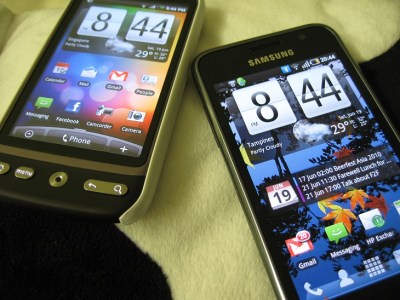
For me, Samsung triumphs in the hardware department (except for maybe the lack of camera flash), whereas Desire wins hand down in the software aspect.
For me, you can address software gap with workaround (sometimes better, sometimes not as good, but its a good workaround), but you can’t say the same for hardware.
For e.g. I was blown away by Samsung camera capability, whereas HTC Sense mesmerized me without a shadow of doubt. I can emulate HTC sense in Samsung Galaxy S via Launcherpro (much better than Sense imho!) and widgets like fancy widget (not as functionally complete but its a good bridge), but I can’t emulate the video taking capability *anywhere near* Samsung Galaxy S in HTC Desire.
Eversince I posted the review of Galaxy S here, which includes a video showcasing the comparison between HTC Desire and Galaxy S, I have received requests to conduct a video comparison in terms of gaming experience. So I installed toonwarz in both smartphones, and here’s the result.
Having tasted my first real Android experience in the mold of HTC Desire, I had another opportunity to lay my hands on Samsung’s new Android flagship product, Galaxy S. I am not sure what does the “S” means, but one cannot be faulted for assuming it is Galaxy “Supreme”, based on its technical specification, and my initial impression of the phone.
In my short 20 minutes hands on, I was deeply impressed by its form factor and its captivating Super Active-Matrix Organic Light Emitting Diode (Super AMOLED) screen. First of all, it’s thin with a 4″ wide screen, a size that I feel more comfortable after having used to HTC HD and HTC HD2, which have screen size of 3.8″ and 4.3″ respectively. I just find the 3.7″ screen in the HTC Desire, a tad too small for me. The Galaxy S has just the right size, and to top it all, it is only 9.9mm slim and weighs only 118g. My only gripe is its piano-finishing battery cover, which is going to be a fingerprint magnet. The fact that the battery cover is made of polyurethanes material, doesn’t make it any more “cheap plasticky”, as I thought the overall build quality is solid.
Now the screen; it looks stunning to the naked eyes, but once I put it side by side against HTC Desire, with the brightness level maximised for both devices, I find the difference is marginal, if any. I suspect the main reason behind this nano difference, is Samsung’s decision to maintain similiar brightness level, so as to maximize the power consumption efficiency. Afterall, a Super AMOLED screen is statistically capable of achieving 20% better brightness at 20% lesser power consumption level, in comparison to a AMOLED screen. So if Galaxy S is designed and manufactured at the same brightness specification as the AMOLED screen, then mathematically one can achieve 33% reduction in the power consumption. Not bad! (Note: I did observed that the power consumption in Galaxy S much better than that in Desire. It’s not scientifically proven though that it is due to the above mentioned theory, but if anybody can confirm that, please let me know)
In the end, the brief experience was enough to lure me into the Samsung Galaxy S camp. So I got a set a few days later, and begin my Android journey, ehm, officially. Afterall, the HTC Desire is technically a “T-loan” unit from yeez, and my other Android experience was really Android Cupcake half baked into my old HTC HD.
Having used the phone for the last few days, my conclusion of Galaxy S and Desire comparison is basically hardware versus software. It is without a shadow of doubt that Galaxy S just shines in almost every aspect of hardware departments, except maybe the flash-less camera (and if I want to be nitpick, lack of LED notification light). I can however forgive the lack of flash, for its superb video taking capability. On paper, it can take 720p video at 30 frame per seconds, but what counts at the end of the day is the actual quality of the video captured in reality. And I have to say it is almighty impressive, as it could take a good video without any ghosting effect. Probably the best video capture capability I have come across for a smart phone.
Now, when it comes to software arena, HTC Desire is the clear winner by a mile. HTC sense and its home screen widgets, spice up the otherwise default boring android home screen. One can draw the similarity from the Windows Mobile devices; that without the Windows Mobile version of HTC sense, it is ladened by a functional but very dated Today screen. HTC has established itself as a smartphone leader, not because of its superior hardware specification, but its ability to mate the hardware and software (regardless of Android or Windows Mobile platform) to address the different needs of various mobile market segments. Samsung, on the other hand, has tried too hard to emulate iPhone, loosing it s own DNA. Its TouchWiz user interface and the bubble style conversation for text messagin, are just some examples of that. Thankfully, there are applications like LauncherPro, which can reinstate the iPhone wannabe back to the real android Galaxy S where it should be.
I have always have the desire to learn about (mobile) life beyond Windows Mobile, after having owned numerous Windows Mobile devices for the past 5 years. Then came iPhone, in 2008. But despite its edge cutting user experience and its hundreds of thousands of (useless) applications, it didn’t wow me over. I admit I’m not a big fan of Apple, but that has nothing to do with me not joining the fruity camp. I think it’s a great mobile product to start with, and had redefined the usability of mobile devices. It forces telco to sell data plan as a mainstream service. There’s many good things about the consumer focused phone, but just not enough to replace the likes of my trusty Xperia, Touch HD and subsequently HD2 as a productivity phone.
Then few months ago, I had a taste of Android on my Touch HD, albeit booted from Windows Mobile using haret (just think of it as a PC that can dual boot between Windows and Linux). I thought Android was an unpolished product then, with a great potential to woo over die hard Windows Mobile users.
In the past 6 months, many Android based phones had launched, but they were either too small for my fat fingers, or did not look appealing to me. Most importantly, until Android 2.1 (or Eclair) was released, there was no good way to integrate Android with Exchange Server backend.
Last month, a couple of new Android Eclair phones were launched, and one of them caught my attention. The phone “Desire” is so aptly named. Sporting a screen of 3.7″ size, running HTC sense and most importantly has support for Exchange Server integration, it looks like a good phone to replace my HD2, which had been on steriod for the past few months.
So when Yeez decides to renew her telco contract, I shamelessly offer her my professional service to set up her HTC Desire, and in the process, for her to experience the steroid boosted HD2 and for me to test-play her HTC Desire for the next few weeks.
But it took me 2 weeks before I could lay my hands on the desirable phone, as the phone was out of stock island-wide since day 1 due to its overwhelming demand and conservative supplies from HTC (as I understood HTC allocated only 100 units to each telco on day one of its release). Fast forward to yesterday, upon first powered up, I was first greeted by the familiar shell interface, HTC Sense, which has been around in other HTC Android and Windows Mobile phones. The Android version of the HTC Sense supports a wide variety of widgets, and I believed it is based on Android App Widgets framework. This is a big contrast to the Windows Mobile version of HTC Sense, which has been developed from ground up, based on Lua scripting language. Ok, it sounds little too techie here, but bottomline, you should be able to customise the Android version of HTC sense with other non HTC-sense widgets easily. In the Windows Mobile camp, you would need skilled developers to custom build additional “home tabs” which will only run on HTC-sense powered Windows Mobile devices. That said, I am alittle annoyed with the fact that I can only have 7 “widget screens”, even though I could work around that “limitation” by choosing different “Scene” (each scene has its own set of home widget screens configured).
Installation of third party applications into HTC Desire, like any other Android phones (and iPhone if I’ve to be politically correct), is seamless through Android Market. I installed a few applications, including big installation packages such as NDrive. There are some installed applications such as SMS widget counter, File explorer, Bluetooth transfer app, etc which I deemed basic and should be part of the Android base system. Or maybe I have been spoilt by Windows Mobile for the last few years. On the otherhand, there are good applications such as Tapatalk which I had been hoping for during the Windows Mobile days, and I reckon the lack of “easy to use” UI SDK as the main reason why developers are slow in porting their applications to Windows Mobile.
Applications aside, setting up HTC Desire was a breeze, in particular setting up Exchange Server account for my push mail needs. In a few minutes, all my company mails, calendars and contacts were downloaded to the phone. While the PIM features in Desire (or Android phones for that matter) is not as extensive as that in Windows Mobile, it’s more than adequate for one to connect to workplace, e.g. scheduling a meeting with a list of invitees, setting out of office,looking up company’s global address book, etc. And because I had setup my HD2 favorite people previously, the Desire’s favorite widget screen shows the same list of favorite contacts after synchronising with the exchange server. Neat!
Now here comes my biggest gripe(s), to date. I always pin-secured my phones, and its no different for HTC desire. The problem with HTC Desire, and possibly for any other Android phones, is that if I choose to have numeric pin, I would still face a full qwerty keyboard to enter the pin when I try to slide unlock the phone. It may sounds like nitpicking, but just imagine you have to tap 8 key codes quickly every time you turn on the phone to make a call or do a quick read of new messages. It didn’t help that Android phones (or at least for HTC Desire) seem to have only one single power management mode; regardless of whether the phone is on external power source or battery, or whether the phone is idle or running some active services.
Apart from these gripes, there are other small nags such as occasional screen lags, inability to have full access to application configurations (probably require rooting). Still, I think it has been a refreshing experience, and is thesmart phone that is capable of replacing my HD2. This is even more so with the next version of Android, Froyo, rumoured to be available for HTC Desire in a couple of weeks time, and reportedly to be 5 times as fast as Eclair. Of course, since its made by HTC, one can easily head over to xda-developers to satisfy ones desire for the dark side.






 zen online journal